Cross stitch for beginners: your first piece
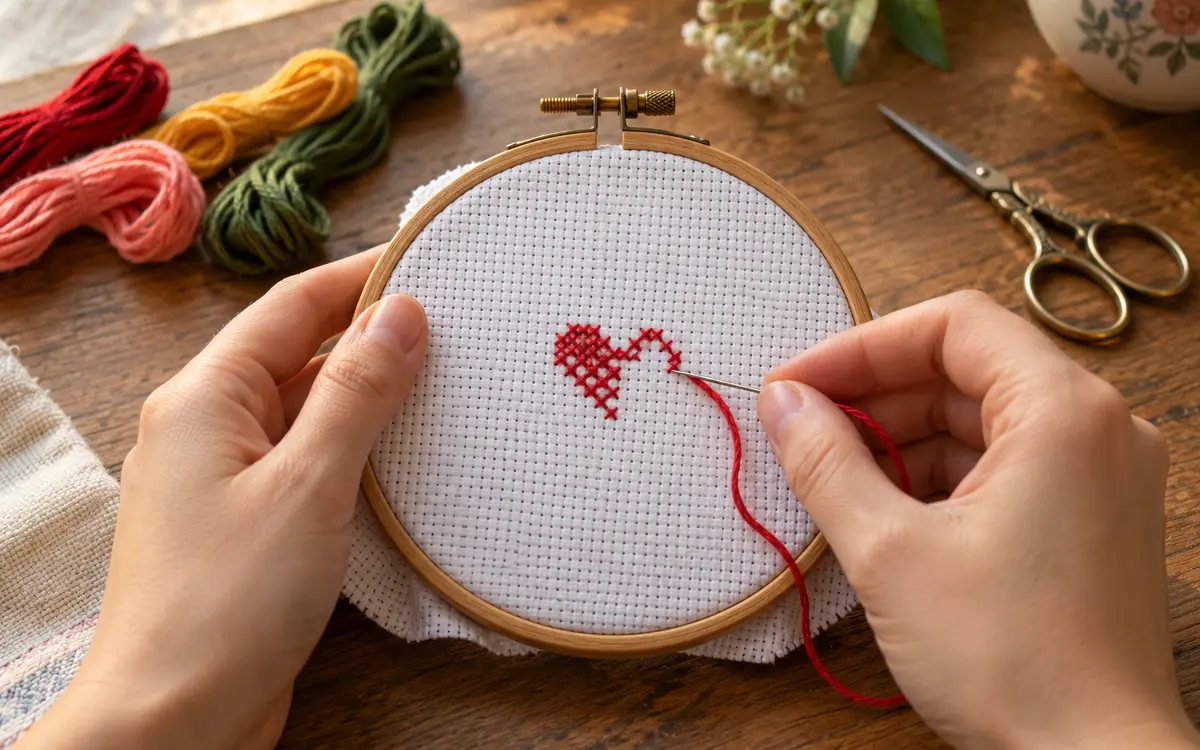
Cross stitch is one of the easiest kinds of embroidery: there is only one basic stitch, and the chart tells you exactly where it goes. With a few supplies and a small design, you can finish your first piece in an evening.
What you need
- Fabric: 14-count Aida (14 squares per inch) in white or ivory. A piece about 8 × 8 inches is plenty for a small design.
- Needle: a blunt tapestry needle, size 24. It slips through the holes without splitting the fabric.
- Floss: six-strand cotton embroidery floss. On 14-count Aida you stitch with 2 of the 6 strands.
- Hoop: 6 to 8 inches across. It keeps the fabric taut so your stitches stay even.
- Small scissors and a chart – for a first project, a design of no more than 40 × 40 stitches with just a few colors.
Get ready
Cut your fabric with at least 2 inches of margin around the design. To stop the edges from fraying, tape them with masking tape or zigzag them on a sewing machine. Fold the fabric in half lengthwise and crosswise: the crease marks the center. Start there – the center of the chart is marked with small arrows on the edges. Our guide How to read a cross stitch chart explains the symbols.
Cut a length of floss of about 18 inches and gently pull out 2 of the 6 strands – one at a time, so nothing tangles. Longer threads twist and wear thin from being pulled through the fabric over and over.
Start without a knot
Bring the needle up from the back and leave a 1-inch tail behind the fabric. Hold the tail with a finger and cover it with your next four or five stitches. It is then secure and you can trim what is left.
The neater option is the loop start: take one strand twice as long, fold it in half and thread both ends through the needle. After the first half stitch, pass the needle through the loop at the back – done, with no tail at all.
The cross stitch
A cross stitch is two diagonal stitches over one square. Stitching in rows gives the most even result:
- Work all stitches of one color in a row as half stitches first, from bottom left to top right (/).
- On the way back, work the top stitches from bottom right to top left (\) to complete the crosses.
- The only rule: all top stitches lean the same way. Which way you choose doesn't matter – just stick with it.
Single, scattered stitches are easier to make as complete crosses one at a time. Don't pull the floss too tight: it should lie gently on the fabric without squeezing the holes together.
Finish a thread
At the back, run the needle under four or five stitches and trim close. Don't jump more than about three squares at the back to a new spot – long floats show through light fabric. For longer distances, finish off and start again.
Common beginner mistakes
- Miscounting: count in blocks of ten and compare with stitches you've already made. A mistake you spot early is quick to unpick.
- Twisted floss: let the needle dangle now and then; the thread untwists by itself.
- Top stitches in different directions: it only shows at the end, so keep the same direction from the start.
- A first project that's too big: a bookmark or a card makes you want to start the next piece – a huge unfinished project doesn't.
Once the design is done, you can outline it with backstitch, usually with a single strand (see How to backstitch). How to wash, press and frame the finished piece is in Wash, press and frame.
Your first own design
A heart, your initials or a little animal: in the Stitchmio pattern maker you draw the design square by square and print it for free as a PDF with symbols and a color key. Ready-made ideas are under Free patterns.
Frequently asked questions
What is the best fabric for beginners?
14-count Aida. The holes are easy to see, every square is exactly one cross stitch, and the stitches are not too small.
Should I tie a knot at the start?
Better not. Knots create lumps and can pull through the fabric. Hold a thread tail at the back and cover it with your first stitches instead – or use the loop start.