How to fix cross stitch mistakes
Everyone miscounts. What matters is noticing early – and knowing which mistakes need frogging (rip it, rip it) and which ones you can simply work around.
Decide first, cut later
| Mistake | Usually enough |
|---|---|
| A single stitch is missing | add it, even at the very end |
| A motif is off by one square and stands alone | leave it and line up the rest with it |
| A frame or border is off by one square | frog it – otherwise the ends won’t meet |
| Wrong color, a few stitches | frog, or leave it if the shade is close |
| Wrong color, a whole area | consider keeping the new color: change the key instead of frogging |
| One cross with the top stitch the wrong way | undo just the top stitch and lay it again |
| A row counted twice in a filled area | leave out one row in a spot where it doesn’t show |
How to unpick cleanly
The last few stitches: unthread the needle and pull the stitches out in reverse order with the blunt needle, alternating front and back. Don’t stitch backwards with the needle threaded – you will split the floss.
A larger area:
- Mark what has to go on the front, for example with pins.
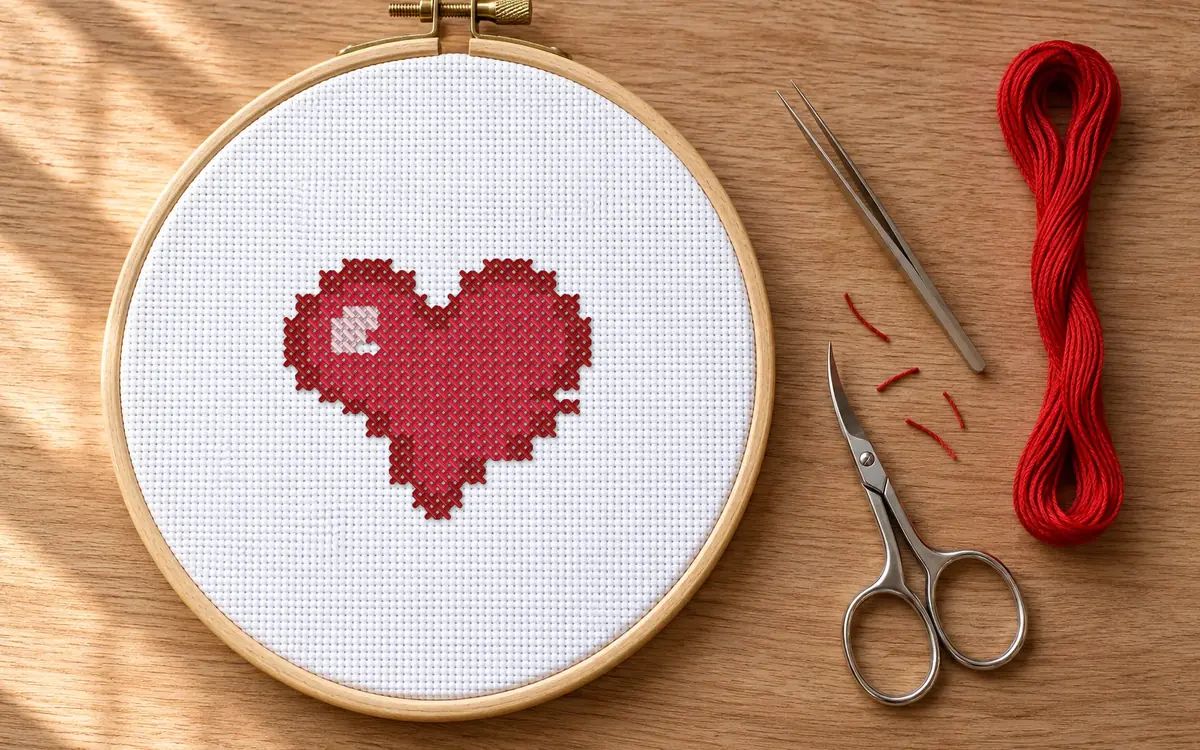
- On the front, snip only the top legs of the crosses with small pointed scissors, two or three at a time. That way you can always see that no fabric thread is in between.
- Pull the pieces out with tweezers, top legs first, then the lower ones.
- Leave 2 to 3 inches at the edges, or unpick by hand there until you can run the end under four stitches. Otherwise the correct stitches next to it come loose.
- Dab off the fuzz with tape.
Miscounted: adjust the pattern instead
If a motif sits one square too far left, you don’t necessarily have to unpick. It is often easier to adapt the pattern to your stitching. In the editor, pick the motif with the select tool (key S), move it by one square and print the page again. Now the chart matches your fabric, and you don’t have to recount in your head on every row.
The same idea helps with a frame around the whole piece: if you end up one square short, select one side of the frame with the select tool in the editor, move it by one square and fill the gap with the pencil.
Top stitches going the wrong way
A single cross whose top leg runs the other way catches the light. Snip only the top leg, pull the ends to the back and secure them as far as they reach. Then lay the top stitch again with a new thread in the right direction. If there are many, it usually looks calmer to finish the area “wrong” throughout.
A hole or cut in the fabric
If you cut a fabric thread while unpicking, iron a small piece of lightweight fusible interfacing to the back and stitch over it. For a larger hole, place a piece of the same fabric underneath, square on square, and stitch through both layers. Under cross stitches it won’t show.
Bleeding color, stains, marks
- Color bleeds: rinse right away with cold water until it runs clear. Don’t let it dry and don’t iron it – heat sets the dye.
- Hoop marks: take the hoop off after every session. Existing rings usually wash out. More in Wash, press and frame.
- Pen won’t come out: always wash out water-soluble marks before ironing, and test the pen on a corner first.
Not enough fabric
If you are only an inch or two short for hooping, sew strips of cotton fabric around the edges. If the design itself doesn’t fit, it has to shrink: reduce the margin in the editor or leave out an element. You can check beforehand with the fabric calculator.
How to avoid most of it
- Find the center of the fabric and start there, not in a corner.
- Transfer the 10-stitch grid lines to the fabric with a water-soluble pen or basting thread. The printed chart already has them.
- Compare with the chart after every block of ten.
- Check off finished rows – on paper with a highlighter, or with “Track rows” on a tablet.
- Stop when the light gets bad.
Common questions
Can I reuse floss I have unpicked?
Better not. It is roughed up and kinked and looks duller next to fresh floss. For a stitch or two, the rest still on your needle is usually enough.
How do I get rid of fuzz after frogging?
Dab the spot gently with a strip of tape and pull leftovers with tweezers. With dark floss on white fabric, a wash in lukewarm water afterwards is worth it.
Will the holes in the Aida close again?
Aida has fixed holes that stay as they are. Distorted spots and hoop marks usually disappear when you wash the piece and press it from the back.
Do I have to frog every mistake?
No. Ask yourself whether you can see it from three feet away and whether later stitches depend on it. If neither is true, it may stay.