How to knit and measure a gauge swatch
Your gauge tells you how many stitches and rows fit into 4 inches with your yarn, your needles and the way you knit. Only then do you know how big a chart will be – and whether the sweater will fit.
Why a few stitches matter
A pattern assumes 22 stitches per 4 inches and has you cast on 220 stitches: that is 220 ÷ 22 × 4 = 40 inches around. If you knit more loosely and get 20 stitches per 4 inches, the same 220 stitches measure 44 inches – four inches more. Hats and socks show the same effect, just in smaller numbers.
Step 1: knit the swatch
- Yarn and needles: use exactly the yarn you plan to knit with and the needle size from the pattern or the yarn label.
- Size: cast on enough stitches for about 6 inches – at 22 stitches per 4 inches that is 33 or more – and knit about 6 inches tall. A few garter stitches (knit every row) at the edges keep the swatch from curling.
- In pattern: swatch stockinette (knit the right-side rows, purl the wrong-side rows) for stockinette, and the colorwork itself for a stranded design. Colorwork often comes out tighter than plain knitting.
- In the round if the piece is: a quick “speed swatch” works on a circular needle: knit right-side rows only, slide the stitches back to the other end and carry the yarn loosely across the back.
Step 2: wash and dry
Treat the swatch the way you will treat the finished piece: wash or steam it, lay it flat and let it dry. Many yarns change in the process – wool often softens and spreads a little, cotton can grow in length. An unwashed swatch doesn’t show the real size.
Step 3: measure
- Lay the dry swatch flat without stretching or pressing it.
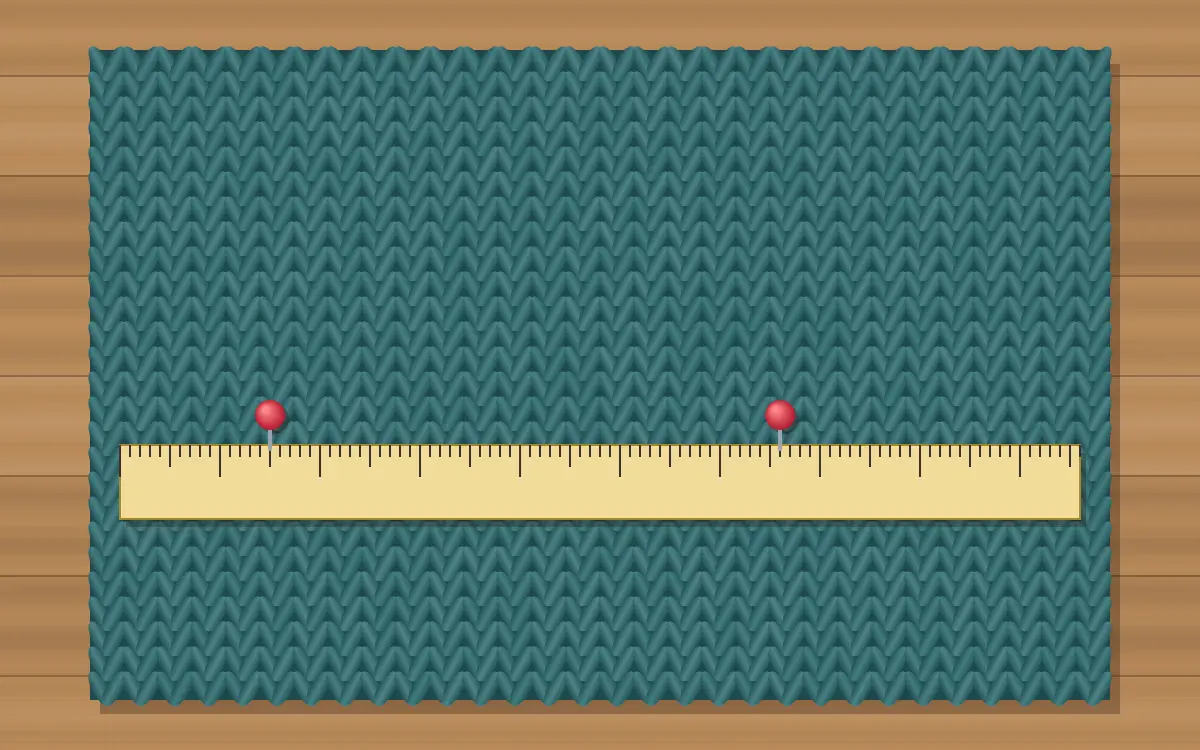
- Place a rigid ruler horizontally across the middle, away from the edges. Count the stitches over 4 inches, half stitches too – on the right side each stitch looks like a small V.
- Place the ruler vertically and count the rows over 4 inches: one V per row.
- Measure in two or three places and take the average.
Say you get 22 stitches and 30 rows per 4 inches. Stitches are wider than they are tall – which is why a motif that looks round on square graph paper comes out stretched sideways when knitted.
Step 4: adjust or convert
If your swatch doesn’t match the pattern, you have two options:
- Change needles: more stitches per 4 inches than the pattern? Go up a needle size. Fewer? Go down. Then knit a new swatch.
- Convert the stitch count: pattern stitches × your gauge ÷ pattern gauge. 220 stitches at 22 become 220 × 20 ÷ 22 = 200 stitches at your 20. For patterns with a repeat, round to a multiple of the repeat.
The knitting gauge calculator does both: the finished size from stitches and rows, and the stitch count for a target width, rounded to your repeat if you like.
Gauge in the pattern maker
In the knitting chart maker you enter your swatch under “Settings” at “Gauge (per 4 × 4 in)”. The squares then take the real stitch shape, and the finished size is shown below the chart. That is how you fit borders with a repeat, such as the fir tree or snowflake border, to your width. How to knit stranded colorwork from a chart is explained in Colorwork knitting from a chart.
Frequently asked questions
Do I really need a gauge swatch?
For anything that has to fit – hats, sweaters, socks – yes. For scarves, shawls and blankets the exact size matters less; there the swatch mostly helps you estimate yarn and see whether you like the fabric.
Why is my gauge different in the round?
Knitting flat, every other row is purled; in the round you knit almost only knit stitches. Many knitters purl a little looser or tighter than they knit, so gauge often differs. Swatch the way you will knit the piece.
How big should the swatch be?
At least a 4 × 4 inch area to measure plus an edge. About 6 × 6 inches lets you measure in the middle, where stitches are even. For stranded colorwork go a bit bigger and swatch in pattern.
Can I stretch the swatch after washing?
Only as much as you will block the finished piece. Let it dry flat and measure once it is completely dry and has rested without tension.