How to resize a cross stitch pattern
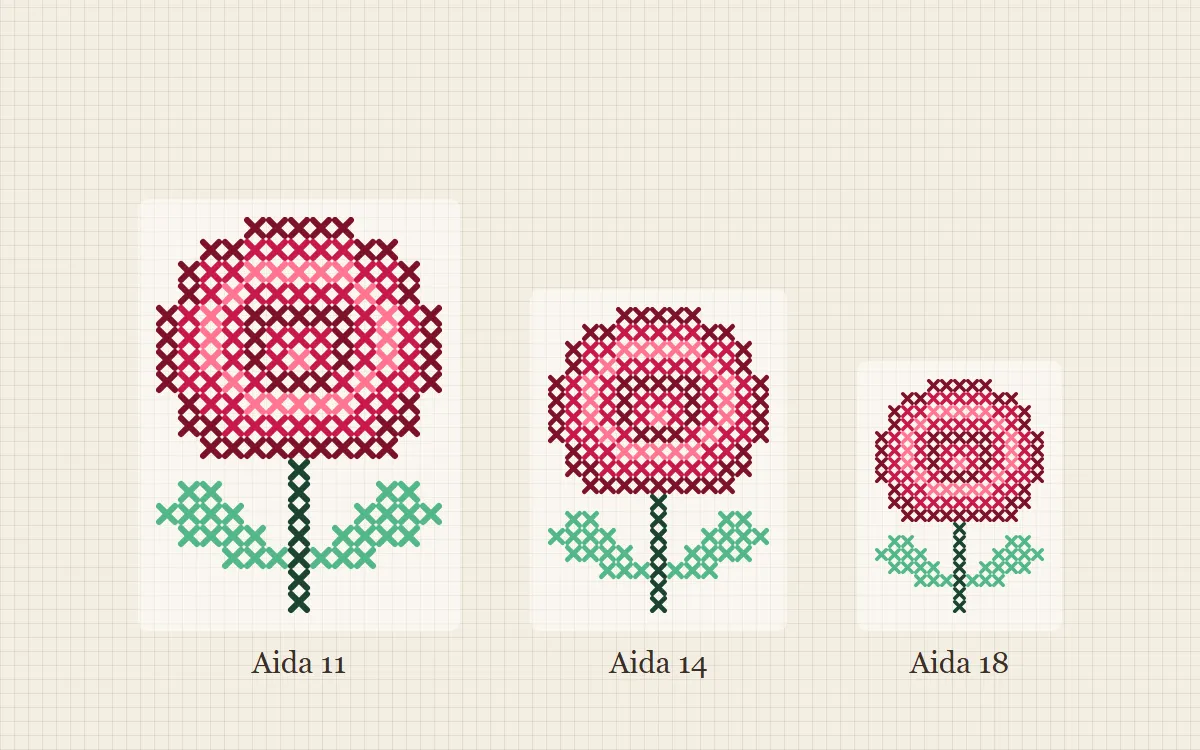
A chart doesn’t fit your frame, or looks too small on a pillow? The size of a cross stitch piece depends on two things: the number of stitches and the fabric. You can change either – and usually a different fabric is all it takes.
Why printing bigger changes nothing
Every square in a chart is exactly one cross stitch on the fabric. Print the chart bigger and only the squares on paper grow – you still stitch the same number of stitches on the same fabric. A big printout is still handy: it is easier to read.
Option 1: a different fabric
The fabric count says how many squares fit into one inch. Coarser fabric makes the picture bigger, finer fabric makes it smaller – without losing a single stitch. The rule:
Size in inches = stitches ÷ fabric count
The table shows how wide a design of 70 and of 110 stitches becomes on common fabrics:
| Fabric | 70 stitches | 110 stitches |
|---|---|---|
| 11-count Aida | 6.4 in | 10.0 in |
| 14-count Aida | 5.0 in | 7.9 in |
| 16-count Aida | 4.4 in | 6.9 in |
| 18-count Aida | 3.9 in | 6.1 in |
| 28-count linen over two | 5.0 in | 7.9 in |
| 28-count linen over one | 2.5 in | 3.9 in |
On 11-count Aida you usually need one more strand (3 instead of 2) so the stitches cover the fabric; on 18-count, 1 to 2 strands are often enough. More in Choosing floss and colors. The fabric calculator works out the size for any fabric, plus how much fabric to cut with a margin.
Option 2: linen over one or two threads
On linen and evenweave you usually stitch “over two”: one cross stitch spans two by two threads. 28-count linen then gives the same size as 14-count Aida. Stitch “over one” and the picture halves – very fine work for practiced eyes. All about fabrics is in Aida, linen or evenweave?
Option 3: more or fewer stitches
To make the picture bigger on the same fabric, you need more stitches – in other words a new chart:
- From a photo: convert the photo again at the width you want. In Stitchmio you set the width in stitches under photo to pattern; more stitches bring more detail, but also more work.
- A drawn motif: doubling means turning every stitch into a block of 2 × 2 stitches. The picture gets twice as wide and tall but looks blockier. It often looks better to smooth the edges afterwards with half stitches.
- Making it smaller: fewer stitches mean less detail. Redraw small motifs rather than removing stitches – with clear shapes and few colors they stay recognizable.
More room on the fabric
If you only need more space, for a name under the motif for example, change the grid’s width and height under “Settings” in the pattern maker and choose on which side the new space goes. The motif keeps its size. Then move it into place with the selection tool.
Frequently asked questions
Can I just print a cross stitch chart bigger?
A bigger printout only makes the squares on paper bigger, not the stitched picture. The finished size depends only on the stitch count and the fabric.
How do I work out the finished size?
Divide the number of stitches by the fabric count to get inches. 70 stitches on 14-count Aida: 70 ÷ 14 = 5 inches.
Do I lose detail when I make a pattern smaller?
Not when you switch to a finer fabric – every stitch stays, it just gets smaller. Detail is only lost when you use fewer stitches.