How to plan a colorwork hat so the repeat fits
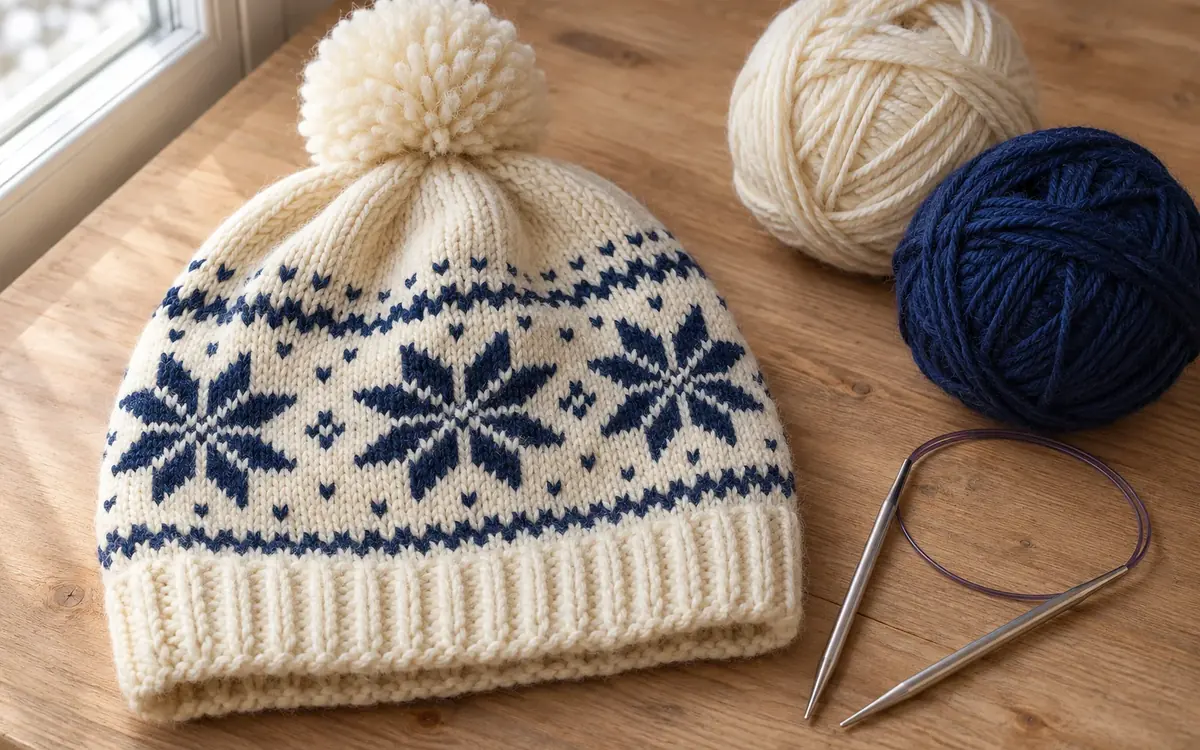
A hat is the best first project with two colors: knit in the round, quick to finish, and the pattern runs all the way around. Only one thing is tricky – does the repeat fit your stitch count exactly?
1. Circumference and gauge
Measure around the head, over forehead and ears, and subtract 1 to 2 inches. For a 22-inch head, plan about 20.5 inches. Then knit a gauge swatch in the pattern and in the round. All you need is the number of stitches per 4 inches.
Stitch count = circumference × stitches per 4 inches ÷ 4. At 22 stitches: 20.5 × 22 ÷ 4 = 112.75, so about 113 stitches. The knitting gauge calculator does this for you and can round to whole repeats.
2. Round to the repeat
The repeat is the part of the pattern that comes again and again. Your stitch count has to be a multiple of it. For our free borders, at 22 stitches per 4 inches and around 113 stitches, these options work:
| Border | Repeat | Height | Stitch counts that fit (circumference) |
|---|---|---|---|
| Peerie border | 4 sts | 9 rounds | 112 sts (20.4 in) or 116 sts (21.1 in) |
| Norwegian dot (lice) pattern with diamond band | 6 sts | 21 rounds | 108 sts (19.6 in) or 114 sts (20.7 in) |
| Zigzag border | 8 sts | 9 rounds | 112 sts (20.4 in) or 120 sts (21.8 in) |
| Snowflake border | 10 sts | 11 rounds | 110 sts (20.0 in) or 120 sts (21.8 in) |
| Fir tree border | 12 sts | 13 rounds | 108 sts (19.6 in) or 120 sts (21.8 in) |
| OXO border (Fair Isle) | 18 sts | 13 rounds | 108 sts (19.6 in) or 126 sts (22.9 in) |
Choosing between two options is a matter of feel: go snugger for soft, stretchy wool and roomier for a firm fabric. Half a needle size moves the circumference by roughly another half inch.
3. Combining several borders
If you stack two patterns, you need a number both fit into – the least common multiple. Fir trees (12) and peerie (4) get along at 108 or 120 stitches, fir trees (12) and snowflakes (10) only at 60, 120, 180. That makes 120 a friendly number: it works with almost every small repeat.
4. Divide up the height
A close-fitting adult hat is usually 8 to 8.5 inches tall, more with a folded brim. At 30 rounds per 4 inches, 8.4 inches are 63 rounds. One way to split them:
- Ribbing, knit 2, purl 2: 2 inches, 15 rounds. The stitch count has to be divisible by 4; with 110, 114 or 126 stitches, work the ribbing knit 1, purl 1, or increase or decrease to the pattern count after the ribbing.
- 2 plain rounds, one border of 13 rounds, 2 plain rounds: 17 rounds, about 2¼ inches
- plain up to the decreases: 9 rounds, 1¼ inches
- crown decreases: about 22 rounds, close to 3 inches
The pattern looks best at forehead height. Plan it so that it ends before the decreases – then you never have to decrease within the pattern.
5. Crown decreases
Divide the stitches into eight equal sections – eight times 15 for 120 stitches. Knit two together at the end of each section and repeat every other round, toward the end every round. If the number doesn’t divide by eight, use six or ten sections, or decrease a few stitches evenly before you start the crown.
6. Check your floats
The unused yarn travels along the back. As a rule of thumb, a float should span at most 5 stitches (about 1 inch); catch longer ones in the middle. Everything about that is in Colorwork knitting from a chart.
Try the repeat in the editor
Open a border in the editor and tap “Preview repeat” below the colors. You see the pattern several times side by side, and you can type in the number of stitches in your round: the editor tells you how often the repeat fits and which stitch count works out exactly. Draw a border of your own in the knitting chart maker, with true stitch proportions from your gauge.
Common questions
How much smaller than the head should a hat be?
For a close-fitting hat, most knitters plan 1 to 2 inches less than the head circumference, because knitting stretches. Colorwork stretches less than plain knitting, so subtract the smaller amount there.
What if my repeat doesn’t fit?
Use the nearest stitch count that works and adjust the width with your needle size, add one filler stitch in the main color between repeats, or pick a different border. Half a repeat at the start of the round always shows.
Can I stack two borders?
Yes. The stitch count has to be a multiple of both repeats. 120 stitches, for example, work with repeats of 4, 6, 8, 10, 12, 15 and 20.
How do I avoid the jog at the start of the round?
Put the start of the round at the back. When changing colors, it helps to slip the first stitch of the second round in the new color instead of knitting it – the step becomes less visible.